
A common misconception among active DeFi traders and builders is that the best wallet is simply the one that promises the strictest security checklist. That’s seductive but incomplete. Security matters, of course — it is fundamental — but the operational model behind a wallet, the visibility it offers into on-chain mechanics, and the ways it reduces human error are equally important for power users. Rabby Wallet positions itself precisely around those operational primitives: transaction simulation, automatic network switching, and pre-signature risk scanning. Understanding how those features change the attack surface and user behavior is the useful step beyond slogans.
This article examines Rabby as a case study: what its mechanisms do, where they materially reduce risk for U.S.-based DeFi users, where they leave gaps, and how to think about trade-offs when choosing a multi-chain browser wallet. I assume you are comfortable with EVM basics (accounts, approvals, gas), but I’ll unpack the simulation, revocation, and multi-sig integrations at a mechanism level so the implications are decision-useful.
How Rabby changes the pre-signing decision — mechanism, not magic
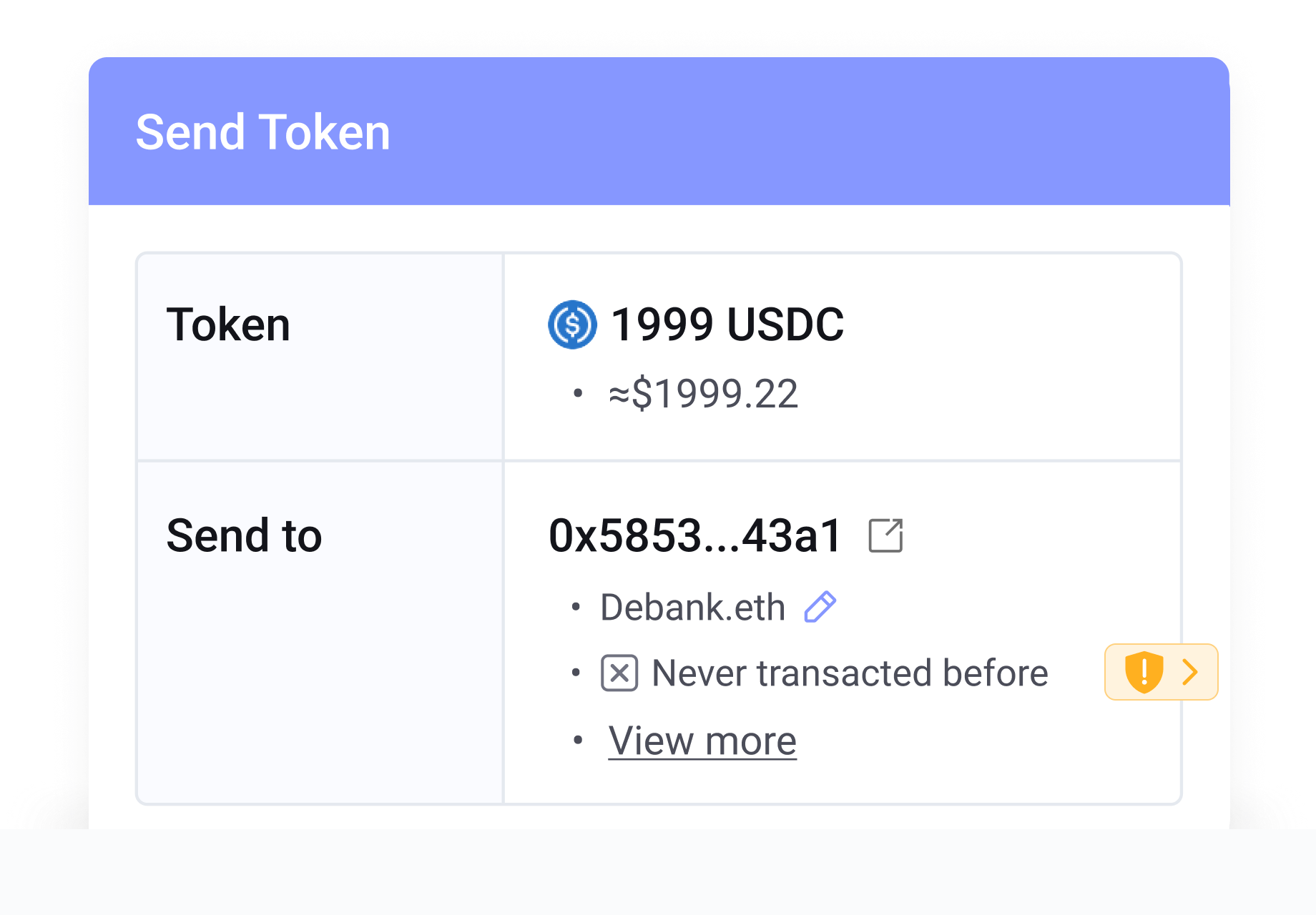
At its core, Rabby’s standout feature is transaction simulation: before you sign, the wallet runs the transaction through a local or remote EVM execution engine and shows the expected token balance deltas and fee estimate. Mechanistically, this takes an abstract data payload — a raw transaction — and converts it into the concrete outcomes that matter to users: “You will lose X tokens, receive Y, and pay Z in fees.” That transforms signing from blind trust into a verification step.
Why this matters: blind signing is the root cause of many on-chain losses. Phishing dApps, or malicious router contracts, often craft transactions that behave differently from their UI text. Simulation forces a simple cognitive check: does the simulated outcome match the UI promise? When used habitually, it converts a behavioral vulnerability into a technical checkpoint.
Limitations to acknowledge: simulation is powerful but not omnipotent. It can only reveal what the EVM execution produces given the current chain state; it cannot detect off-chain oracle manipulations that influence future behavior, nor can it retroactively prevent a compromised private key from being used elsewhere. In addition, accurate simulation depends on node fidelity and the wallet’s access to up-to-date chain state. For a power user, simulation reduces probability of accidental loss but does not eliminate systemic smart-contract risk.
Risk-scanning, approval revocation, and operational hygiene
Rabby pairs simulation with a pre-transaction risk scanner and an in-wallet approval manager. The scanner flags known-bad contracts, suspicious approval amounts, or nonexistent recipient addresses; the revocation tool lets you revoke token allowances from contracts you previously approved. Mechanism-wise, this tackles two common attack vectors: malicious approvals (a contract allowed to transfer unlimited tokens) and reuse of past approvals after a contract compromise.
Operational trade-offs are clear. Revocation tools are extremely valuable for minimizing lingering exposure, but power users should balance revocation with protocol usability: some DeFi strategies (e.g., frequent arbitrage or automated market-making via a bot) rely on persistent approvals to avoid repeated UX friction. A best-practice heuristic is to use scoped approvals (smaller amounts), revoke large approvals on dormant contracts, and retain high-frequency approvals only when combined with other mitigations like hardware wallets or multi-sig control.
Rabby’s integration with hardware wallets and institutional custodians (Ledger, Trezor, Gnosis Safe, Fireblocks, etc.) is another mechanism to reduce key compromise risk. For teams or high-net-worth individuals, combining Rabby’s simulation and scanning with a multi-sig or institutional custody flow alters the risk calculus: a stolen browser key no longer implies immediate theft, because policy controls and separate signers intervene.
Multi-chain convenience versus a widening attack surface
Rabby supports over 90 EVM-compatible chains and automatically switches networks to match the dApp you visit. For active US-based DeFi users, that convenience saves time and reduces human error from manual chain switching — a simple but common cause of failed trades or mistaken approvals. However, adding chains also broadens the universe of contracts, bridges, and RPC endpoints you interact with, which can increase exposure to poorly audited code and malicious RPC nodes.
Mechanistic mitigation here is twofold: first, prefer well-known RPC providers or run your own node; second, treat chains differently based on maturity. For example, Ethereum mainnet and popular L2s have more safety margins from audits and active monitoring, whereas niche chains may lack robust explorer coverage and security tooling. Rabby’s portfolio aggregation and gas top-up feature (to send gas tokens across chains) are operational aids — they do not substitute for a disciplined risk taxonomy that treats each chain as a distinct security domain.
Important known limitations that matter in practice: Rabby currently lacks a built-in fiat on-ramp and does not provide native in-wallet staking. For U.S. users accustomed to integrated fiat rails, this means maintaining off-wallet custody or using reputable centralized exchanges to purchase assets before moving them into Rabby. For staking, you will rely on external protocols or custodial staking services; the absence of native staking reduces complexity but may be inconvenient for users who prefer consolidated flows.
Past incident as a learning case: Rabby Swap exploit and response
In 2022 a smart contract tied to Rabby Swap was exploited for roughly $190,000. The team froze the contract, compensated users, and increased audit activity. This episode is instructive: it shows both that integrated services create concentrated risk and that developer responsiveness can materially reduce fallout. From a risk model perspective, the incident demonstrates two truths: vulnerabilities often occur at the contract layer (not the wallet UI), and remediation speed plus transparency matters when losses happen.
How to translate that into practice: treat integrated swap features as convenience, not insurance. Prefer using separate, audited DEX contracts where possible, and keep limited balances for single-click swaps. If you rely on a wallet swap aggregator, check whether it uses on-chain routes you can inspect and whether the wallet publishes audit summaries for its swap infrastructure.
Decision framework for DeFi power users
Here is a compact framework you can apply when deciding whether Rabby is the right browser wallet for a specific role or task.
– Task criticality: For high-value operations (large token transfers, treasury actions), use hardware multi-sig plus Rabby’s simulation and scanning. The wallet should be an approval interface only; signing should require multiple custodians.
– Frequency versus exposure: For high-frequency, low-value trades, scoped approvals and a hardware wallet can provide a balance between speed and safety. For infrequent, high-value positions, favor multi-sig and explicit manual checks.
– Chain maturity filter: Limit automatic behavior on experimental chains. Disable automatic RPCs for unknown networks and use explicit node choices for sensitive transactions.
– Behavioral rule: Never sign without confirming the simulation matches the dApp UI. When in doubt, export the raw transaction and simulate it in an independent environment (or ask a colleague to re-check).
Practical how-to pointers for U.S. users — operational checklist
– Install Rabby as a Chromium extension (or use the desktop client) and connect it to a hardware wallet for any value above a personal risk threshold.
– Enable transaction simulation and read the balance deltas before signing; insist on readable amounts rather than “unknown” token labels.
– Use the approval revocation tool monthly or after interacting with unfamiliar dApps; revoke unlimited allowances by default.
– For institutional flows, pair Rabby with Gnosis Safe or Fireblocks so signing requires multiple human approvals.
– Keep funds for on-chain activity separate from long-term cold storage; use Rabby for operational balances and hardware or cold storage for reserves.
For readers ready to try Rabby or to download the browser extension, official links and install instructions are available here.
What to watch next (signals, not predictions)
Three conditional signals will change Rabby’s relevance for power users: broader native fiat integrations (would reduce friction but increase regulatory surface), built-in staking (would consolidate flows), and deeper institutional integrations (would move Rabby from a user wallet toward an enterprise tool). If Rabby adds native fiat rails, watch for custody trade-offs and KYC implications. If it introduces staking, confirm whether they hold keys or act purely as an interface. Each feature brings convenience but also new security and compliance trade-offs to evaluate.
FAQ
Does Rabby prevent all smart-contract exploits?
No. Rabby reduces certain human-driven risks (blind signing, careless approvals) through simulation and scanning, but it cannot stop vulnerabilities that are intrinsic to a smart contract’s logic or those caused by compromised off-chain components like oracles. Treat Rabby as a strong defensive layer, not a perfect shield.
Is Rabby safer than MetaMask for DeFi power users?
Safer in certain operational dimensions: Rabby’s transaction simulation, risk scanning, and approval revocation give measurable benefits over a standard MetaMask workflow. However, safety also depends on how you use the wallet: combining Rabby with hardware keys and multi-sig solutions is what achieves institutional-grade security, not the wallet alone.
Can I use Rabby for institutional custody?
Yes. Rabby integrates with multi-sig and enterprise custody providers like Gnosis Safe and Fireblocks, enabling institutional workflows. Evaluate integration depth, audit coverage, and operational playbooks before using it for treasury-scale assets.
How reliable is automatic network switching?
Automatic network switching is a convenience that reduces user error, but it depends on accurate dApp metadata and well-configured RPC endpoints. Do not rely on it as a security control; always verify the chain and contract address shown in the simulation before signing.